How Do You Calculate Design System ROI?
When people hear “design system”, most of them think of components, colours and typography. For a company, though, the real question is:
What does this investment actually bring us?
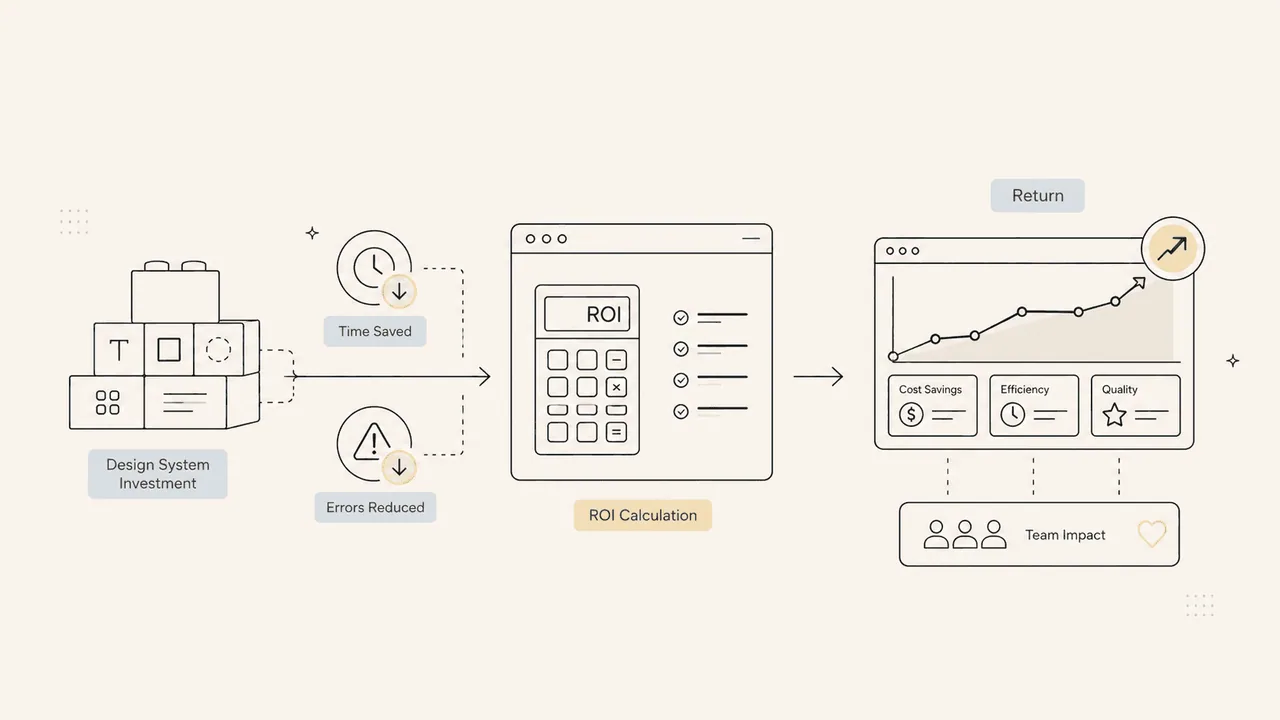
ROI (Return on Investment) is the financial return an investment brings to the company. Calculating the ROI of a design system is not as complicated as you might think.
Let’s walk through a simple example.
Imagine a team of 10 developers. Thanks to standard components and clear documentation, each developer spends on average 30 minutes less per day on building, fixing and making decisions.
This seemingly small difference means savings of:
- 5 hours a day
- about 100 hours a month
- and 1,200 hours a year.
If a developer hour costs you 2,000 TL, this improvement alone is worth roughly 2.4 million TL a year in operational value.
And that calculation doesn’t yet include:
- less repetitive work for the design team
- shorter QA cycles
- fewer bugs
- faster onboarding for new team members
- features shipping sooner
- lower maintenance costs
That’s why the success of a design system should be measured not by how many components were built, but by these metrics:
- Feature development time (lead time)
- Component reuse rate
- Number of bugs and regressions
- Onboarding time
- Less rework in design and development
- Maintenance costs
The real value of a design system doesn’t show up in a Figma file; it shows up in the company’s operational efficiency and financial results. That’s why it should be treated not as a design investment, but as a business investment that speeds up scaling.