

Why Does a Design System Matter to the CTO Too?
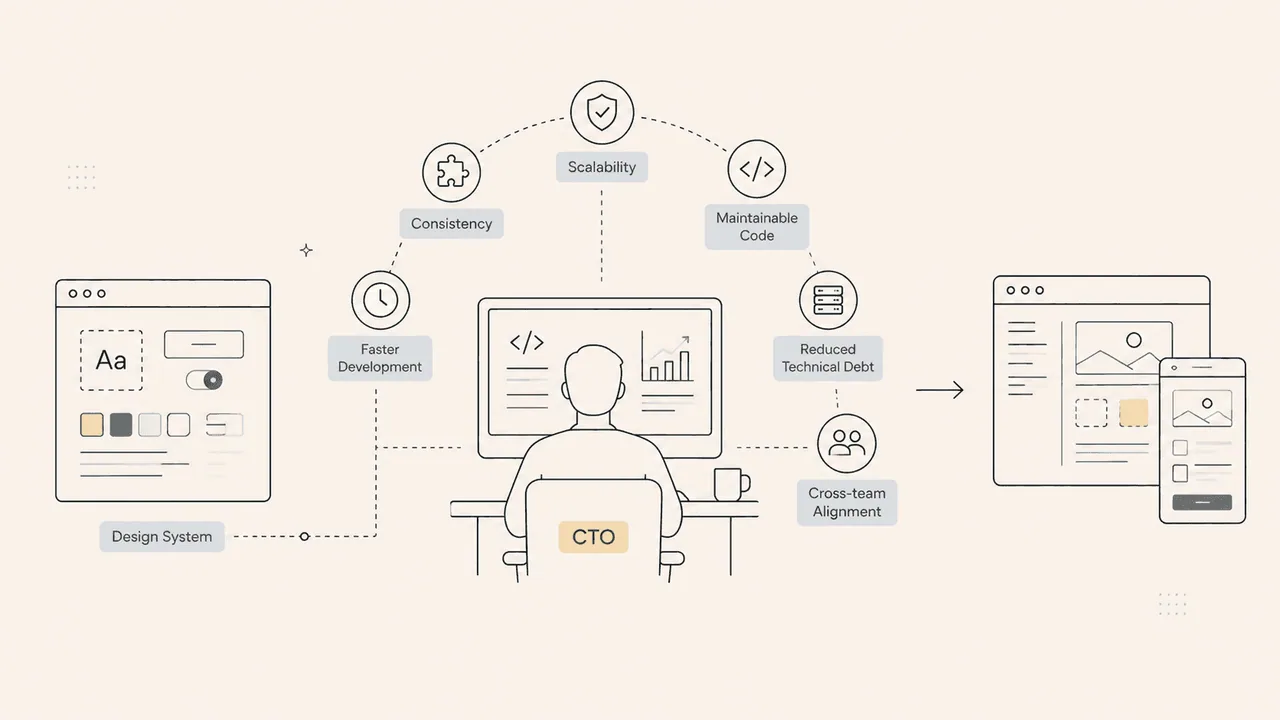
“A design system is the design team’s responsibility.”
You can hear this sentence in many companies. But this point of view misses the real value of a design system.
A design system is a technical foundation that goes beyond design and shapes how products are built. That’s why it belongs on the CTO’s agenda.
1. It directly affects development speed
Every time a new feature is built, the team makes dozens of small decisions.
- What will this button look like?
- How will the modal behave?
- How will form validation work?
- Which spacing should we use?
If these decisions have already been made and standardised, the developer doesn’t have to think them through again.
The result:
- Shorter development time
- Fewer meetings
- Fewer revisions
For a CTO, this means getting more done with the same team.
2. It reduces technical debt
Technical debt isn’t only about code quality.
Five different versions of the same button...
Different input behaviour on different pages...
Components rewritten by every team...
All of these drive up maintenance costs over time.
With a well-managed design system, developers use shared components, duplicated code goes down and the product becomes more sustainable.
3. It shortens onboarding for new developers
When a new developer joins the team, they have to learn not only the business rules but also the logic of the product’s interface.
Standard components, clear naming and good documentation speed this process up considerably.
For the CTO, that means shorter onboarding and faster productivity.
4. It makes QA easier
Inconsistent interfaces don’t only hurt the user experience; they also make testing harder.
If every screen behaves differently, the number of test scenarios grows.
If the same component behaves the same everywhere, QA teams can focus on real problems instead of repetitive checks.
This cuts both testing time and the error rate.
5. It makes scaling possible
In small teams you can get by without standards.
But as the team grows, the same approach stops working.
The chaos that 5 developers can manage can turn into serious inefficiency in a team of 50.
A design system prevents that mess by creating a shared language as the team grows.
That’s why every big technology company invests in a design system.
The reason isn’t to produce prettier screens.
The reason is to scale faster.
6. It lowers operational costs
Many managers calculate the cost of building a design system.
What really needs calculating is the cost of not building one.
Screens redesigned every sprint...
Components built again and again...
Endless UI fixes...
QA cycles that keep getting longer...
All of these are invisible but ever-growing operational costs.
A design system is a standard that reduces them.
ROI from the CTO’s perspective
A CTO’s success criteria usually are:
- Faster delivery
- Lower maintenance cost
- Fewer bugs
- Higher development quality
- Easier scalability
A good design system contributes to every one of these goals.
That’s why ROI isn’t measured only by the question “how many components did we build?”
These metrics are far more meaningful:
- Feature development time (lead time)
- Component reuse rate
- Work delivered per sprint
- Number of UI-related bugs
- Onboarding time
- QA time
- Code duplication rate
- Release frequency
Conclusion
Seeing a design system as a tool used only by design teams is a big mistake.
A well-built design system lets developers work faster, gives product teams a shared language and allows the company to scale at a lower cost.
So investing in a design system doesn’t just produce more consistent interfaces.
It creates teams that build faster, products that are more sustainable and a more efficient technology organisation.
That’s exactly why a design system should be on the strategic agenda not only of the Head of Design, but of the CTO as well.